People close to problems hold the key to their solutions
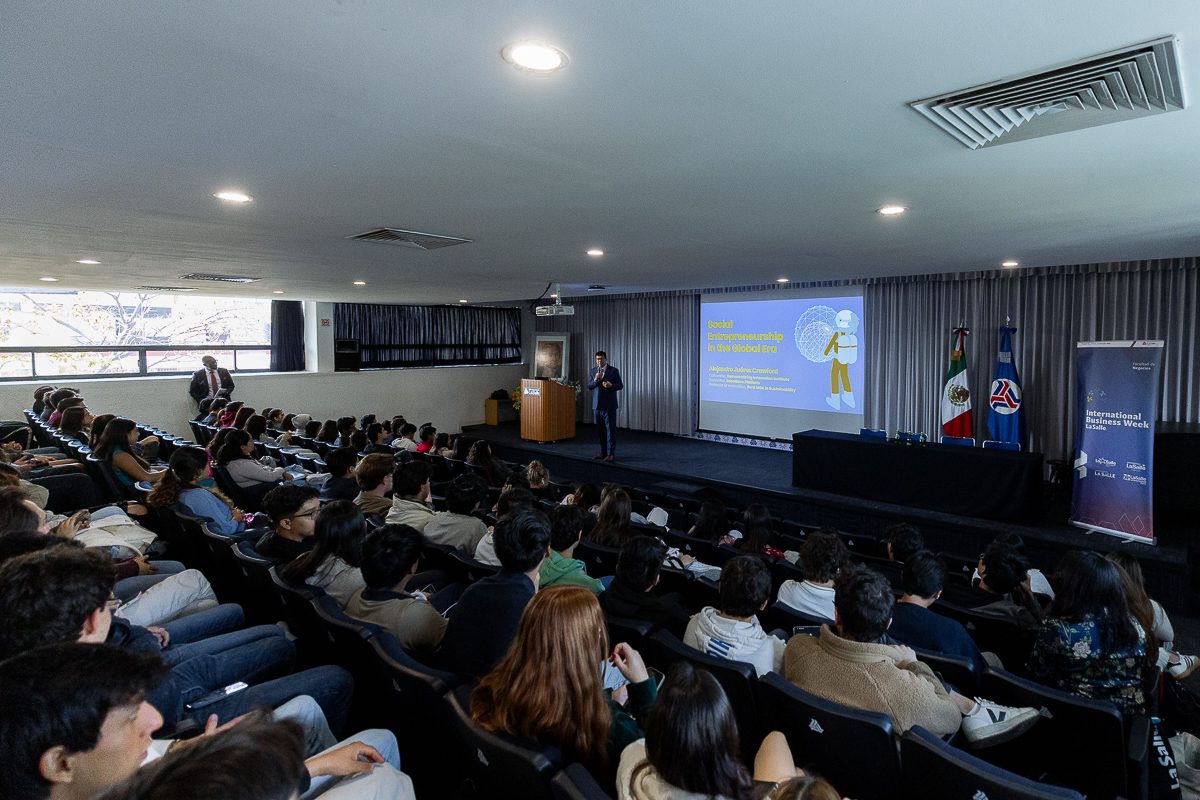
In a series of talks that elicited kinetic energy among participants, institute cofounder Alejandro Juárez Crawford challenged them to identify unresponsive systems around them – and respond with experiments to replace them. Addressing live and virtual audiences across Latin America at Universidad LaSalle International Business Week in Mexico City on October 28th and 29th, Juárez Crawford presented research and case studies from the new book One Size Fits None: Time for an Entrepreneurial Revolution, coauthored with Mim Plavin-Masterman.
At the conference opening, Juárez Crawford delivered the keynote on “Social Entrepreneurship in the Global Age,” presenting both daunting developments– and an opening to do something about them. He challenged participants to ask why the systems they encounter, in public and private institutions alike, have become unresponsive to the needs of those they purport to serve. Then he confronted the audience with the opportunity to replace those systems – not just for a few select innovators, but for the rest of us.
Juárez Crawford referred to Kitty Hawk, North Carolina, where a couple of bicycle mechanics tested flyer after flyer till they invented the airplane. Today, he argued, we have only scratched the surface when it comes to using our digital connections to take advantage of Kitty Hawk opportunities everywhere. Drawing from institute methodologies and research, he showed how we can make a powerful apparatus available to equip participants to become their own innovative problem solvers.
“We are at an inflection point,” said Juárez Crawford. “Young people today face enormous changes and intersecting global crises. At the same time, they’re entering the world at a moment when for the first time in history it could be possible for regular people to create their own experiments to solve the problems around us.”
In a followup the next day, Juárez Crawford dedicated a copy of One Size Fits None: Time for an Entrepreneurial Revolution to the La Salle Library, discussing the book’s evidence about emerging opportunities to tackle the entrenched problems they face with experiments of their own. The book presents experiments conducted in 20+ countries by Juárez Crawford and DI, which works with organizations around the world so they can experiment and find their own solutions. He cited a quotation from the book: “Across cultures and educational levels, people develop the experimental mindset by attempting to derive real-world solutions to problems they identify – and by working with others who think differently and bring new skills and experiences.” Though financial and other resources for social entrepreneurs remain disproportionately concentrated in a few places, he argued, deep local knowledge, available everywhere, can be just as valuable. Crawford concluded by drawing the audience into dynamic debate about what it takes for people closest to problems to draw upon valuable first-hand experience and dogged experimentation. Drawing on DI’s experience, he suggested practical ways to make it normal for people to develop inventive ways of working around obstacles, and replacing the way we do things today.